

How to Choose the Right SDS Core Bit: Sizing & Compatibility Guide
Introduction
Anyone who’s ever drilled holes for pipes, cables or AC lines learns one lesson very quickly: choosing an SDS core bit is not just “pick a size and go”. The wrong diameter, a barrel that’s a little too short, or a shank that doesn’t fit your hammer can turn a simple job into a long, messy day. Maybe the pipe won’t pass through, maybe the bit bottoms out a few millimetres before breaking through, or the hammer simply refuses to drive the bit properly.
Most of these headaches don’t come from “bad tools” but from size and compatibility mistakes made before the order is placed. This guide stays close to the real problems you see on site: which diameter to use, how much drilling depth you really need, whether SDS-plus is enough or you should move to SDS-max, and what arbors and pilots you must have ready. The goal is simple: help you choose SDS core bits that actually fit your hammer, your wall, and your pipe the first time.
Why Size and Compatibility Matter More Than Brand
When the Hole Is “Almost” Right but Not Usable
Picture this: you’ve just drilled a neat 110 mm hole through a concrete wall for an AC sleeve. You try to push the sleeve through and it jams halfway. Once you add insulation and sealant, there’s simply not enough space. The only options left are chiselling the edges, re-drilling, or explaining to the client why the fresh plaster is damaged.
Electricians see the same thing with conduits and cable bundles. The core bit “matches” the conduit size on paper, but not the real outer diameter of fittings, couplings and additional cables. The hole is technically the right size, but practically useless. None of this is about the logo on the barrel. It’s all about taking a few minutes up front to size the SDS core bit around the real thing that has to pass through the wall, not around a nominal number on a drawing.
Common Sizing Mistakes Contractors Make
The patterns repeat from job to job. Someone eyeballs the pipe, grabs “something close” from the box, and only realises it’s too tight when the line is already installed. Another common mistake is reading only the overall length of the SDS core bit and ignoring the effective cutting depth. On paper it looks long enough; on the wall it stops short.
Then there’s the “SDS is SDS” assumption. People buy a core bit, see that it uses an arbor, and assume it will be fine on any SDS hammer. They forget that SDS-plus and SDS-max live in different power classes. Finally, many buyers don’t notice whether their new core bit comes as a complete set or as a bare barrel. They discover on site that they don’t have the right arbor, pilot drill or extension, even though the bit itself is perfectly good.
The Payoff of Getting It Right
When you match the core bit to the job properly, everything else feels easier. Pipes slide through with enough clearance for insulation and sealant. Ducts and sleeves line up with brackets without hammering or grinding the edges. The hammer runs within its comfort zone, so the bit cuts steadily instead of overheating and bouncing around.
You also notice the difference at the end of the month. Fewer holes need rework, the bits last longer, labour time per penetration drops, and the team trusts the setup. Over time, you build a small “go-to” set of SDS core bit sizes that cover most of your work. Once that’s dialled in, choosing the right bit becomes almost automatic, and you can focus on the job instead of fighting the tools.
Step 1 – Understand Your SDS System: SDS-Plus vs SDS-Max
What SDS Actually Means
SDS is simply the way the bit connects to the rotary hammer. Instead of a smooth round shank clamped by jaws, an SDS shank has slots that lock into matching ridges inside the chuck. The bit can slide a little in and out while still being driven, which lets the hammer transfer impact energy into the masonry.
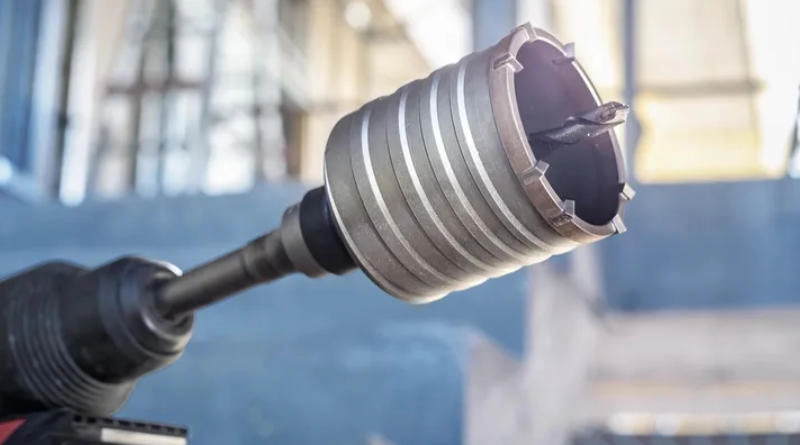
For core drilling, everything hangs off that connection. The core barrel itself is usually threaded; it screws onto an arbor, and that arbor carries the SDS shank. If the SDS type on the shank doesn’t match the chuck on your hammer, the whole setup stops there. That’s why understanding “what SDS system you actually own” is the first decision, before you even talk about diameter or drilling depth.
SDS-Plus vs SDS-Max: What’s the Difference in Practice?
On site, SDS-plus and SDS-max behave like two different families. SDS-plus hammers are lighter, easier to carry, and perfect for anchors, small chasing and medium-size cores. They’re the everyday tools for many electricians and plumbers. SDS-max hammers are heavier, hit harder and are built to swing big chisels and large core bits into tough concrete all day.
You can often find overlapping core diameters that exist in both SDS-plus and SDS-max systems, but how they feel in use is completely different. An 82 mm core bit might be fine on a strong SDS-plus hammer in brick, but the same diameter in dense concrete may really belong on SDS-max. When you know which side of that line your work usually falls on, it becomes much easier to choose the right SDS core bit range.
How to Identify Your Hammer Drill Type
If your hammer has been in the van for years and the label is half gone, there are still quick ways to identify it. Pull out a bit you know fits. SDS-plus shanks are relatively slim and have two open keyways and two closed grooves. SDS-max shanks are noticeably thicker, with three open slots spaced around the shank.
You can also look for “SDS+” or “SDS-max” printed on the tool body or in the user manual. Failing that, the weight tells you a lot: a compact two–three kilo hammer is almost always SDS-plus; machines above five kilos are usually SDS-max. Once you know which platform you’re on, you can read the manufacturer’s recommended maximum core bit diameters for that tool and use them as your starting point.
Step 2 – Define the Hole Diameter You Really Need
Start from What Goes Through the Hole (Pipe, Duct, Cable Bundle)
The right way round is simple: start with the thing that has to fit through the hole, not with the bit sitting in your toolbox. Measure the real outer diameter of the pipe, conduit, duct sleeve or cable bundle. Don’t trust nominal sizes; many “110 mm” items are a little bigger once you include fittings, insulation or protective sleeves.
Then think about what else needs space in that same hole. Firestop collars, foam, mortar, or rubber grommets all eat into the clearance. If you only match the core bit to the bare pipe size, everything feels tight, and you end up forcing things through or shaving the edges. When you size around the actual installed assembly instead, the core bit choice becomes much more straightforward.
Clearance Rules of Thumb for Different Applications
There’s no single magic number for clearance, but a few habits help. For rigid water pipes passing through a simple brick or block wall, many installers are comfortable with just a few millimetres of play all around. That’s enough to position the pipe and fill the gap with foam or mortar.
For electrical work, a bit more space is often wise, especially if you expect future cable additions or firestop systems. HVAC penetrations, especially insulated lines and ducts, usually need even more room so the insulation isn’t crushed and collars sit properly. In practice, that often means selecting a core bit one or two standard sizes above the measured outer diameter, and sometimes more for bulky sleeves. The key is to make that decision deliberately instead of discovering after drilling that everything feels like it’s wedged in.
Typical SDS Core Bit Diameter Range on the Market
SDS core bits don’t come in every possible millimetre. Manufacturers offer stepped series that are meant to cover most common jobs: 30–40 mm for small conduits and cables, 52–65–72 mm for mixed plumbing and electrical, 82–102 mm and beyond for bigger penetrations. SDS-max opens the door to even larger sizes.
Because of these fixed steps, your “ideal” calculated diameter will often land between two catalogue sizes. When that happens, the safer choice is almost always to move up to the next available diameter, not down. Once you’ve mapped which pipe and conduit combos you see all the time, you can choose a core bit series that lines up with those sizes and stops you from reinventing the wheel on every project.
Step 3 – Match Drilling Depth to Wall or Slab Thickness
Overall Length vs Effective Cutting Depth
The length figure printed in bold on a product page is usually the overall length. It’s the total physical length of the barrel and sometimes includes the threaded section. That number looks nice, but it doesn’t tell you how deep you can actually drill.
Effective cutting depth is the distance you can drill into solid material before the shoulder of the barrel or the arbor hits the surface and stops you. It’s always shorter than the overall length because it excludes the base, internal connection and some of the segment area. When you’re planning to go through a 240 mm wall or a thick floor slab, this difference matters a lot. If you only look at overall length, you can easily choose a bit that simply won’t break through in one go.
How to Calculate Required Depth
Start with a tape, not with guesswork. Measure the structural layer you’re going through and add the finishes on each side—tiles, plaster, screed, boards. A 200 mm concrete wall with 15 mm plaster on both sides suddenly becomes 230 mm of material to pass. Then add a little safety margin for uneven surfaces and a slightly off drill angle.
If you need the hole to extend beyond the strict structural thickness—maybe to allow a sleeve to sit flush, or to give a drain pipe its fall—add that extra depth too. Once you have that total, compare it directly with the effective cutting depth in the SDS core bit spec, not the overall length. Having a bit that offers 10–20 mm more effective depth than the number you calculated is usually enough to give you relaxed drilling instead of “hoping it just makes it”.
When to Use Extension Bars and When Not To
Extension bars are useful, but they’re not a cure-all. Fitting an extension between arbor and barrel gives you extra reach for the occasional deep penetration without buying a new, longer SDS core bit. For straight-through holes at comfortable working height, that’s a very practical solution.
The downsides show up when the setup gets too long for the situation: working on ladders, overhead, or in awkward corners. The tool becomes nose-heavy, harder to keep straight, and more likely to twist if the bit grabs. With big diameters, the leverage on the hammer’s bearings goes up too. So it’s usually smarter to treat extensions as a backup for odd cases, not as your main strategy. If you’re constantly reaching for an extension on the same kind of job, it’s probably time to buy a longer core barrel or rethink how you approach that penetration.
Step 4 – Check Your Hammer Drill’s Capacity and Power
Tool Class, Impact Energy, and Recommended Max Diameter
Every hammer drill has a point where it’s working with you, and a point where you’re just punishing it. The easiest way to locate that line is to read the manufacturer’s recommended maximum drilling diameters. They usually give separate values for solid bits and core bits in concrete or masonry.
An SDS-plus hammer with modest impact energy might be perfect for 30–65 mm cores day in, day out. The same tool will feel sluggish and unhappy if you put a 100 mm core into dense concrete. An SDS-max hammer, with higher impact energy and more mass behind it, is designed to handle those larger diameters without drama. When you’re choosing SDS core bits, match the bit size to the tool’s recommended range instead of assuming “if it fits, it’s fine”.
Why “Oversizing” the Bit on a Small Hammer Is a Bad Idea
Many people try it once: “I only need a few big holes, I’ll throw this large core bit on my small SDS-plus hammer and be careful.” In reality, you end up leaning on the tool, watching dust build up, feeling the motor strain and smelling warm windings. Progress is slow, vibration is high, and both the bit and the hammer suffer.
Under-powered hammers glaze segments, slip clutches and stress gears. The operator gets tired and risks losing control when the bit snags. The job takes longer than if you’d either chosen a smaller diameter that still works for the application, or rented/used a stronger SDS-max hammer for that portion. Oversizing the bit on a small hammer isn’t “saving money”; it’s shifting the cost into wasted time and reduced tool life.
Rotation-Only vs Hammer-Drill Modes for Core Bits
Core bits don’t all like to be treated the same way. Some TCT SDS core bits are built to run in hammer-drill mode, using impact to chip away at the concrete. Many diamond-tipped barrels, especially for harder materials, prefer rotation-only with moderate pressure. Hit them with full hammer action and you can crack segments or damage the bond.
Your hammer usually has symbols for rotation-only, hammer drilling, and chiselling. The core bit packaging or datasheet will normally state which mode is allowed. It’s worth matching the two. Using hammer mode when the bit was designed for rotation-only can be an expensive experiment. Forcing rotation-only on a TCT core in hard aggregate can be painfully slow. Check the instructions once, choose the right setting, and you’ll notice the difference in both drilling feel and bit life.
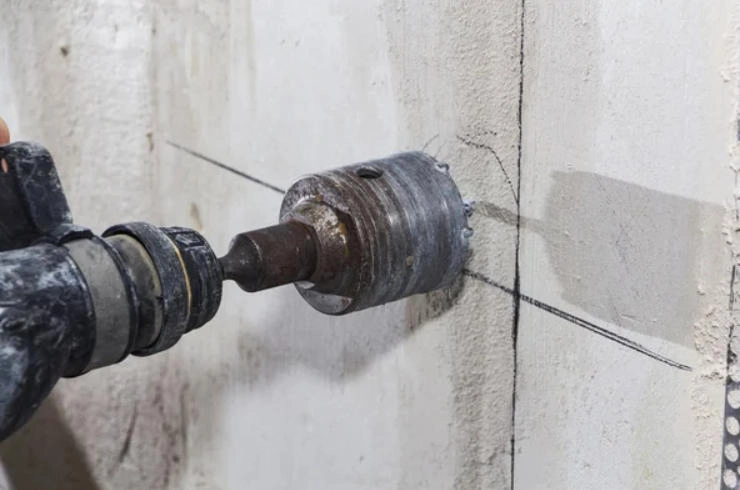
Step 5 – Get the Arbor, Pilot Bit, and Adapter Correct
The Role of the Arbor in an SDS Core Bit System
With SDS core bits, the barrel is only half the story. Most barrels end in a thread or specialised connection; they need an arbor to link them to the SDS chuck. That arbor has two jobs: connect mechanically to the barrel and run true in the hammer so the core bit spins straight.
When you choose an SDS core bit, check the thread type on the barrel and make sure your arbor matches it. Also confirm whether the arbor has an SDS-plus or SDS-max shank to match your hammer. It sounds basic, but mismatched threads or shanks are a surprisingly common reason why brand-new bits sit unused. A good arbor, correctly matched, gives you a solid, concentric setup that feels smooth in your hands and produces round, accurate holes.
Pilot Drill / Center Bit: Do You Need One?
A pilot drill in the middle of the arbor does not make the hole any bigger, but it makes the first few seconds much calmer. It bites into the surface ahead of the core bit and keeps the barrel centred, especially on smooth concrete, plaster or tile. If you’re drilling overhead, on a ladder or on a finished wall, that extra stability is worth a lot.
There are times when you’ll take the pilot out: when you’re enlarging an existing hole, drilling very soft materials, or when you know there’s reinforcement sitting close to the surface and you’d rather let the core bit meet it than a slender pilot. It’s smart to have the option. When buying, check whether your arbor accepts pilot bits, and consider keeping a couple of lengths handy so you can adapt to different wall thicknesses and situations.
Using Adapters to Run Core Bits on Non-SDS Machines
Adapters that let you clamp an SDS shank in a three-jaw chuck do exist, and they’ll physically connect some SDS core setups to a regular drill. For small diameters in soft materials, this can work as a one-off fix. But it’s not the same as running the bit on a true SDS hammer.
Standard drills aren’t designed for sustained hammering into concrete with a big, heavy core hanging off the front. The chuck can slip, the motor overheats, and the whole tool becomes hard to control. For serious core drilling in concrete or hard brick, the safer and less frustrating path is to use an SDS hammer that was built for the job. Consider adapters a temporary bridge for light work, not a long-term solution for heavy coring.
Step 6 – Consider Overall Length, Access, and Working Position
Drilling in Tight Corners, Near Ceilings, or Behind Fixtures
On a clear, open wall, overall length hardly seems worth thinking about. But add a ceiling, a staircase, a radiator or a cabinet, and suddenly the length of the SDS core bit plus the hammer becomes critical. If the rear handle hits the opposite surface before the bit is fully engaged, you simply can’t drill there, no matter how good the bit is.
Before choosing long barrels, imagine where you’ll actually be standing when you drill. Do you often work in service rooms with low ceilings? Do you drill behind toilets, fan-coil units or kitchen cabinets? It can be smarter to choose a shorter core barrel that just covers your typical wall thickness and use extensions occasionally, rather than always fighting an over-long setup in cramped spaces.
Ergonomics: Operator Height, Working Angle, and Control
A large SDS-max hammer with a long core bit looks powerful on the floor. Held at shoulder height for ten minutes, it feels very different. The longer and heavier the setup, the more it pulls you off balance and the harder it is to keep steady on the mark. Shorter operators feel this even more.
Good ergonomics means choosing SDS core bit lengths and diameters that match both the task and the people using the tool. For frequent overhead or ladder work, compact setups are safer and easier to control. For waist-height drilling into open walls, larger and longer bits are more manageable. Thinking about real body positions and working angles when you buy bits will cut down on fatigue, misaligned holes and the risk of losing control if the bit catches.
Balancing Reach with Stability
Every extra piece you add—another extension, a longer barrel—adds a little more flexibility into the system. That flexibility can translate into wobble at the cutting edge, especially with big diameters. Wobble means oval holes, chattering, and extra wear on the arbor and hammer.
You don’t have to chase maximum reach on every purchase. It often works better to have two or three well-chosen barrel lengths that cover your usual wall and slab thicknesses, and a sensible extension for unusual cases. That way your default setup stays short, stiff and accurate, and you only stretch things when there’s no other choice. The right balance between reach and stability depends on your projects, but the principle is the same: stable first, extended only when you truly need it.
Step 7 – Real-World Sizing Scenarios by Trade
Electricians: Conduit and Cable Bundle Penetrations
Electricians usually care more about repetition than raw size. You may drill dozens of similar holes for conduits, risers and cable bundles. In that situation, it pays to match a few SDS core bit diameters exactly to your most common conduit and bundle combinations.
For example, one smaller diameter for single conduits, one mid-size for a couple of conduits or a modest bundle, and a larger one for bigger cable groups or junction box penetrations. The effective cutting depth only needs to cover the typical walls you see in your type of buildings. Once you’ve built that “electrician set”, you can almost drill on autopilot: see the conduit bundle, grab the matching SDS core bit, and know the hole will have enough space for today and for a few extra cables tomorrow.
Plumbers: Water, Heating, and Drain Lines
Plumbing work brings everything from slim water lines to thick heating and drain pipes. Here, SDS core bit sizing is driven by both the pipe and how it’s installed. Press fittings, elbows close to the wall, insulation, clips and collars all steal a bit of space around the line.
For small diameter water pipes, a moderate amount of clearance is fine, especially if you’re sealing with foam or mortar. For heating and drainage, you often want more room so you can adjust slope and route the pipe without knocking chunks off the hole edge. It often makes sense for a plumber to standardise on a handful of core diameters that align with their favourite pipe sizes and fitting systems, instead of always grabbing the nearest bit. That way holes look consistent, seals are easier, and there’s enough room to make small adjustments without breaking plaster.
HVAC Installers: Duct and Sleeve Openings
HVAC work is where SDS-max really earns its keep. Penetrations for insulated lines, drain pipes and small ducts quickly push above the comfortable range of SDS-plus, especially in dense concrete or thicker walls. Here, the game is all about giving bulky assemblies enough space without taking out half the wall.
Start with the full outer diameter of the insulated bundle or sleeve, then add what you need for collars, gaskets and sealant. It’s normal for the chosen SDS core bit size to look “big” compared to the bare pipe, but that extra room pays off when you pull lines through and set the final positions. For very large duct openings, there’s a point where a dedicated core drill rig is more sensible than trying to make an SDS system do everything. Knowing where that point lies in your own work will keep both schedules and tools healthier.
General Contractors: Multi-Purpose Use on Site
General contractors don’t always know in advance whether today’s hole is for a plumber, an electrician or a data line. What they do know is the type of buildings and wall thicknesses they usually handle. That’s a good starting point for assembling a versatile SDS core bit set.
A practical approach is to pick a small group of diameters that collectively cover typical electrical, plumbing and light HVAC penetrations, plus one or two larger sizes for occasional special cases. Combine that with barrels long enough for your standard wall thicknesses and you’ll be equipped for most ad-hoc requests. When a job clearly needs something much bigger or deeper, you can then decide whether to invest in extra SDS core bits, bring in a specialist, or rent dedicated coring equipment.
Step 8 – Pre-Purchase Checklist: 8 Questions to Answer Before You Order
Quick Question Checklist
Before money leaves your account, run through a short checklist:
- What hammer will you use—SDS-plus or SDS-max—and what is its recommended maximum core diameter in concrete or masonry?
- What exactly goes through the hole, and what is its real outer diameter with insulation, couplings, or bundling included?
- How much clearance do you want around that component for adjustment, slope and sealing?
- How thick is the wall or slab, including both sides’ finishes?
- What effective cutting depth does the SDS core bit actually offer?
- Is your hammer realistically powerful enough to drive that diameter in the material you’re drilling?
- Do you already have the right arbor, pilot drill and any extension bars, and do they match the barrel’s thread and your SDS shank?
- Are there tight spaces, ceilings or obstacles that might force you to use a shorter barrel or a different drilling position?
If you can answer these questions calmly, you’ve already avoided most of the usual traps.
Turning the Checklist into a Simple Decision Flow
You can turn that checklist into a quick habit. Start with the tool: identify the SDS system and note the maximum core size. Move to the application: measure the real outer diameter of whatever passes through, decide on your clearance, and round up to the nearest available SDS core bit size. Check the wall or slab thickness, compare it with effective cutting depth, and pick a barrel length that gives you a margin instead of scraping the limit.
Then ask whether your hammer has the muscle for that size in the material you’re facing. Confirm that your arbor, pilot drill and any extensions actually fit the chosen barrel and shank. Finally, picture yourself standing at the drilling point: is there enough room to get the hammer and core bit straight on the mark? Once a planned combination passes those steps, you can place the order knowing you’re buying an SDS core bit that will actually do the job, not just look good in the box.
FAQ: Google-Style Questions About SDS Core Bit Size & Compatibility
What size SDS core bit do I need for a 110 mm duct or pipe?
Start with the real outside diameter of the duct or sleeve, not just “110 mm” on the drawing. Measure it with insulation or grommets in place if they’ll pass through the wall as one piece. Then think about how easily you want it to slide and what seal you’ll use. For a tight but workable fit with foam or mortar, a core bit a few millimetres larger can be enough. If you want easier handling, more tolerance and space for extra insulation, move up one or two standard SDS core bit sizes. In many setups, that means something like 112–120 mm rather than exactly 110 mm, depending on what your supplier offers.
Can I use an SDS-Plus core bit for large diameters, or do I need SDS-Max?
SDS-plus hammers are fine for small and medium cores in normal masonry and lighter concrete. If you stay inside the diameter range suggested in the tool manual, you’ll usually be happy. Once you move into genuinely large diameters in dense concrete—typical HVAC sleeves, bigger drains—it’s time to think SDS-max or a dedicated coring rig. You might physically mount a big barrel on SDS-plus using an arbor, but the hammer will be running flat out, progress will be slow and the tool will wear faster. If large cores are a regular part of your work, investing in SDS-max is more comfortable and more economical over time.
Can I use an SDS core bit in a regular drill with an adapter?
For small, light jobs in soft block or brick, an adapter can get you out of trouble once in a while. It lets you hold an SDS shank in a standard three-jaw chuck. The drill will spin the bit, and you may get the hole done. But it’s not something to build a workflow around. Standard drills aren’t designed to manage the torque and vibration of larger core bits in concrete. The chuck can slip; the drill can overheat; control is poorer. If you expect to do any serious amount of core drilling, a proper SDS hammer plus matching SDS core bits is the right pairing.
How deep can I drill with a standard SDS core bit?
There’s no universal “standard”, but most stock SDS core bits are designed to handle typical wall thicknesses in the markets they’re sold into. That might mean a single brick or block wall with plaster, or a concrete wall in a residential building. To know what your bit will really do, look for the effective cutting depth in the datasheet. Compare that to your measured wall or slab thickness plus finishes. If the two numbers are very close, you’re working on the edge; any unevenness can leave you short. Choosing a bit with a bit more effective depth than you strictly need gives you breathing room and a cleaner breakthrough.
What’s the difference between overall length and effective cutting depth?
Overall length is the “front to back” measurement of the core bit (and sometimes the arbor connection). It tells you how long the piece of metal is, not how deep a hole you can drill. Effective cutting depth is the real working figure: it measures from the tip of the segments back to the point where the barrel or arbor will hit the surface and stop you going further. For planning penetrations, that’s the number that matters. If you ignore it and rely on overall length, it’s very easy to assume a bit can go through a wall that is, in practice, too thick.
How do I know if my hammer drill is powerful enough for a certain core bit size?
The simplest way is to read what the manufacturer says. Most hammer drill manuals list maximum core drilling diameters for concrete and masonry. If the SDS core bit you’re considering is bigger than that, you’re asking for trouble. If it’s close to the maximum, expect slow drilling and higher wear, especially in hard material. Also trust your own experience. If the hammer already feels strained with your current largest core, jumping one or two sizes up is unlikely to be enjoyable. When in doubt, either step down the bit size (if the job allows) or step up the hammer.
Do I always need a pilot drill for SDS core drilling?
Not always, but in many situations it makes life easier. A pilot drill gives the core bit something to follow, which reduces wandering on smooth or hard surfaces and keeps the hole on your mark. That’s particularly useful overhead or on finished walls. You might take the pilot out when widening existing holes or working in very soft material where it sinks too quickly. Some users also prefer to remove it when they know they’ll meet rebar close to the surface. Think of the pilot as a control tool rather than a rule. Having the option to use it or not, depending on the job, is what really helps.