

How to Clean Diamond Polishing Pads
Diamond polishing pads are one of those tools people only think about when something goes wrong. The gloss won’t come up, the surface starts to show mysterious scratches, the pad burns instead of cutting – and the first reaction is usually to blame the product or the machine. In our experience as a diamond tools manufacturer at SENMINE, a large percentage of these problems are actually maintenance issues, especially around how the diamond polishing pads are cleaned and stored.
If you run a stone fabrication shop, a concrete polishing crew, or a floor maintenance team, your pads are working in abrasive slurry all day long. Dust, fines, and resin clog the surface, water dries into a film, and low-grit particles migrate into your finishing steps. Over time, the pad is technically “not worn out”, but it behaves like it is. Learning how to clean diamond polishing pads properly is one of the simplest ways to protect your consumable budget and keep finishes consistent from job to job.
Why Cleaning Diamond Polishing Pads Matters
Cleaning sounds like a small operational detail, but it sits right between quality control and cost control. When the surface of a pad is packed with slurry, the diamonds can no longer bite into the material properly. The pad begins to slide and burnish instead of cutting. Operators respond instinctively by increasing pressure, which generates more heat, glazes the resin, and accelerates wear. At the same time, productivity falls because they have to stay longer on each grit to reach the required gloss.
The hidden cost is not just the extra set of pads you order each quarter. It is also the extra time per countertop, the additional passes over a concrete floor, the rework on dark stone where micro-scratches become visible under light. None of these show up directly on an invoice from a supplier; they show up in overtime, in delayed handover dates, and in callbacks from clients. A good cleaning routine keeps the pad surface open, the diamonds exposed, and the temperature under control, so you get the cutting speed and lifespan the manufacturer designed into the product.
From the purchasing side, this matters because diamond pads are not a one-off expense. For medium and large workshops, they are a recurring line in the budget. When a shop normalizes simple pad care across all teams, it often discovers that one of the easiest ways to “reduce pad cost” is not to buy cheaper products, but to keep good pads working closer to their full potential.
Types of Diamond Polishing Pads
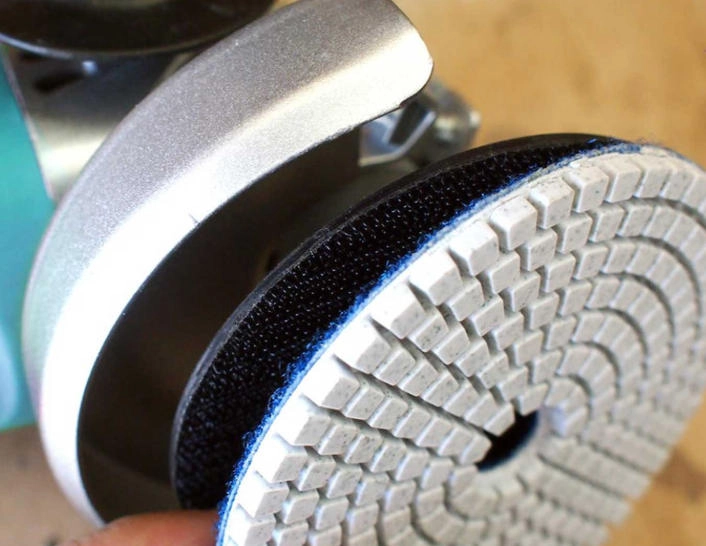
Before you can decide how to clean diamond polishing pads, it helps to look at the types of pads you are using and how they are built. The first category most people meet is the classic wet resin pad: Velcro-backed, used with a water-fed hand polisher on granite, marble, quartz and sometimes concrete. The resin bond in these pads is designed to work in a wet environment. It tolerates frequent rinsing and uses water not only for cooling but also to carry away slurry.
Dry pads sit in a slightly different category. They are still resin-bonded, but the formulation is tuned to handle higher working temperatures and short bursts of friction without a continuous water film. They are popular in indoor remodels and other places where water management is difficult. These pads can usually be rinsed and cleaned with water, but they dislike sudden thermal shock, and they need to cool before you wash them.
On the floor care side, you find large-diameter diamond floor pads that run under single-disc machines or autoscrubbers. They are very thin compared to stone pads, often carry a huge number of very fine diamonds, and are designed for near-daily use in combination with water or mild cleaning solution. The cleaning idea is the same – keep the surface free of packed dirt – but the handling is a bit different because of their size and flexibility.
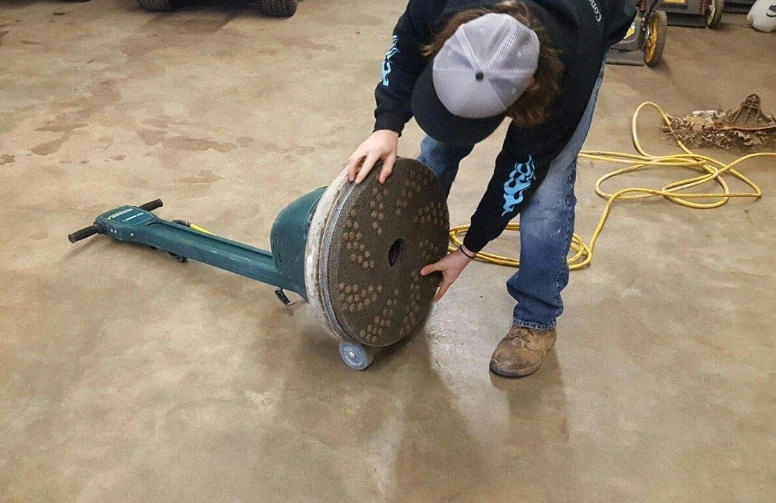
Behind each of these products is a specific bond recipe, backing material, and manufacturing process. At SENMINE, we tune the resin hardness, diamond concentration, and groove pattern according to the material and machine the pad will work with. All of this is invisible to the end user, yet it determines how forgiving the pad will be if it is left dirty, how it reacts to chemicals, and how easy it is to “re-open” the surface with a brush and clean water. When you know which group your pads belong to, it becomes much easier to design one cleaning routine and teach it to your team.
Practical Ways to Clean Diamond Polishing Pads
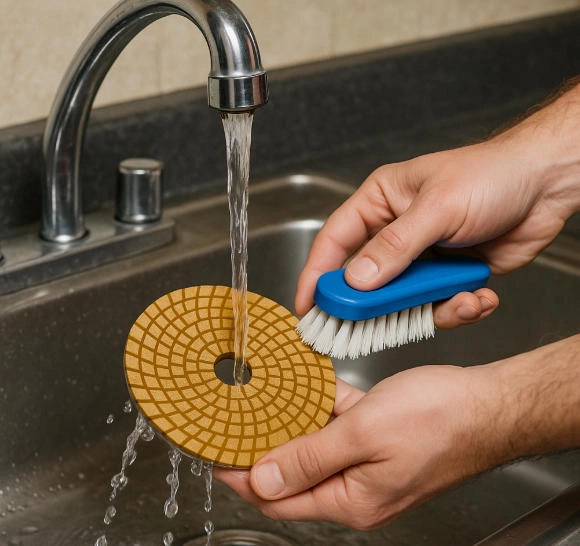
In day-to-day operation you do not need complicated equipment to clean diamond polishing pads. What you really need is a clear habit: pads should not be put away with slurry on them, and they should not go into the next grit stage still loaded with debris from the previous one. The simplest tool is clean running water. After you finish a polishing pass and the pad is no longer hot to the touch, rinsing it under a tap or hose with moderate pressure already removes most of the loose slurry. Holding the pad so water flows from the center outward helps push fines out of the channels rather than deeper into them.
Water alone is often not enough, especially after longer runs on concrete or very dusty stone. This is where a nylon or plastic brush becomes your best friend. Brushing the working face of the pad under running water, following the segment pattern or working in circular motions, breaks up the compacted layer of slurry and exposes the diamonds again. The goal is not to scrub aggressively, but to “open” the surface and remove the material that has filled the space between abrasive particles. In a busy shop, this can be a very short routine: rinse, quick brush, rinse again, set aside to dry.
Dry pads benefit from the same idea, but the sequence is reversed. You start by dealing with dust in a dry way: light tapping to release loose material, a vacuum with a brush attachment to lift fines out of the pattern, and, if available, low-pressure air extraction with proper dust control. Only when the pad is cool do you introduce water, briefly rinse away what remains, and brush gently if the loading is heavy. The important part is to avoid pouring cold water onto a pad that is still extremely hot from dry polishing, because the sudden temperature shock is not kind to any resin bond.
For large floor pads, the work is even more straightforward. Removing them from the driver plate at the end of the shift, rinsing them both sides with a hose, brushing off visible contamination and then hanging them or laying them flat to dry is usually enough. The step that is often skipped is removal from the machine: when a pad is left pressed under the driver, wet and loaded with dirt, it is more likely to deform or bond dirt permanently into its structure.
In some special cases, water and brushing might not be enough. If the pad has been running over sealers, adhesives or oily contaminants, a mild, pH-neutral cleaner designed for stone or floors can help break down those films. The key is moderation. A small amount in a bucket, a short soak, some light agitation, and a thorough rinse afterwards is all you need. Strong acids, high-alkaline degreasers or bleach are tempting when a pad looks badly stained, but over time they weaken the resin and shorten the life of the product.
Cleaning Frequency And Bad Habits
Knowing how to clean diamond polishing pads is only useful if you also decide when to do it. The most effective pattern is not a single “deep clean” once a week, but small, regular interventions over the working day. Many stone shops get good results by rinsing and brushing pads between grit changes, especially from lower to higher grits, and then doing a slightly more thorough clean at the end of the shift. Concrete polishing crews often build the cleaning step into their stage changes: when the machine is already stopped to switch tools, the pads are rinsed and brushed before they go into storage or into the next stage.
What undermines all of this are a few very human habits. One is the idea that a glazed or loaded pad can be “burned clean” by increasing RPM and pressure. In reality, that usually bakes the slurry harder into the resin, overheats the bond, and accelerates glazing. Another is the tendency to throw all used pads of different grits into the same dirty bucket at the end of the day. By the time they come out again, lower-grit particles have migrated into fine finishing pads, and those mysterious scratches at 3000 grit suddenly make sense.
Stacking wet pads on top of each other and closing the lid is another quiet problem. When the pads stick together, operators often pull them apart by force and damage the backing. Trapped moisture also encourages mildew and odor, and in the long term can weaken the adhesive layer that holds the Velcro on. A more disciplined approach – pads laid flat or hung up with air space between them – takes a little more room, but avoids many avoidable failures.
From the manufacturer’s side, we see a very clear pattern when customers send back samples for analysis. Pads that were cleaned regularly with water and soft brushes show a different wear pattern from pads that were left dirty or scrubbed with metal tools and aggressive chemicals. The first group tends to have a predictable, even wear until the working layer is genuinely consumed. The second group often shows premature cracking, bond damage and deep scars in the resin from inappropriate cleaning methods.
When to Replace Diamond Polishing Pads
A common question from purchasing managers and workshop heads is how to tell whether a pad should be cleaned again or simply replaced. The line between “still usable” and “false economy” is not always obvious at a glance, but there are some clues you can build into your internal guideline.
If a pad responds clearly to cleaning – you rinse and brush it, and the cutting speed and gloss noticeably improve – it is still in a healthy phase of its life. If, on the other hand, the pad remains slow and the surface stays shiny and glass-like even after thorough cleaning, the diamonds are probably already worn down or buried in a heavily glazed bond. When the working layer has become very thin and you can see or feel that you are close to the backing, keeping the pad in circulation risks backing contact with the workpiece, which can leave marks or cause the pad to fail suddenly.

Other warning signs include cracks running across the pad, missing sections, or partial delamination of the backing. High-grit pads that suddenly start to produce fine scratches on sensitive materials, even after cleaning, should also be treated with suspicion. At that point the safe choice is usually to remove them from critical finishing work and, if you wish, keep them only for rougher tasks where a flawless appearance is not required.
From a purchasing and planning perspective, the best approach is to combine visual rules like these with basic tracking of usage. If you know approximately how many countertops, how many square meters of floor, or how many hours a pad typically gives you under proper cleaning routines, you can quickly see when something has gone wrong – either in the application or in maintenance – and address the cause instead of just buying more stock.
Manufacturer Tips for Diamond Polishing Pad Cleaning
Cleaning happens in your workshop or on your job site, but good pad design makes the process easier and more forgiving. When you evaluate diamond polishing pads or consider changing suppliers, it is worth looking at details that are directly related to maintenance. Groove patterns that let slurry escape instead of trapping it are easier to rinse. Resins that stay stable under repeated wetting and drying cycles preserve performance longer. Quality backing and adhesive systems survive many washes without peeling.
At SENMINE, we treat “easy to maintain” as part of product design, not an afterthought. We test pads in conditions that are close to real use, not just on clean laboratory samples. This helps us adjust patterns and bonds so that a simple routine of water, a nylon brush and proper drying is enough to keep the pad working well. For OEM customers and distributors, we can also supply clear, brand-neutral cleaning recommendations that you can integrate into your own manuals or training materials, so your teams and clients get consistent guidance regardless of who is on shift.
The goal is very simple: if a buyer invests in a good diamond polishing pad, they should not lose half its value because no one explained how to look after it.
Diamond Polishing Pad Cleaning Best Practices
In the end, how to clean diamond polishing pads is not a mysterious topic. It comes down to a few habits that are easy to teach but powerful over time: rinse in clean water instead of dirty slurry, open the surface with a soft brush instead of harsh tools, let the pad cool before washing if it has been running dry, dry it properly before stacking or storing, and accept that even a well-maintained pad has a natural end of life.
For shop owners, project managers and purchasing teams, treating pad cleaning as part of your standard process – just like grit selection or machine maintenance – is one of the easiest ways to improve finish quality and keep consumable costs under control. For us on the manufacturer side, it is always more satisfying to see our pads scrapped because the working layer is truly worn out, not because a simple cleaning habit was missing.
If you are reviewing your current polishing workflow, setting up a new fabrication line, or looking for OEM diamond polishing pads with clear technical support from the factory, SENMINE can help you choose suitable pad structures and give practical maintenance advice tailored to your materials and machines. That way, you are not only buying a product, but also a working method that makes it last.