

How to Use a Diamond Core Drill: Step-by-Step Guide
Drilling a clean, round hole through concrete or masonry shouldn’t feel like a fight. But when a core bit “walks” on the surface, overheats, jams, or blows out the exit side, the job turns messy fast. This guide breaks diamond core drilling down into a repeatable workflow: safety checks, correct setup, rotary-only drilling technique, wet vs. dry cooling, debris clearing, and practical fixes for stuck bits. Wet methods are also one of the most effective ways to reduce hazardous silica dust when core drilling.
One-page quick checklist:
Before drilling
• PPE on + work area stable
• Scan for wires/pipes (and other embedded hazards)
• Mark center + set drill to rotary-only (no hammer)
• Choose wet vs dry plan (water/slurry or dust extraction)
During drilling
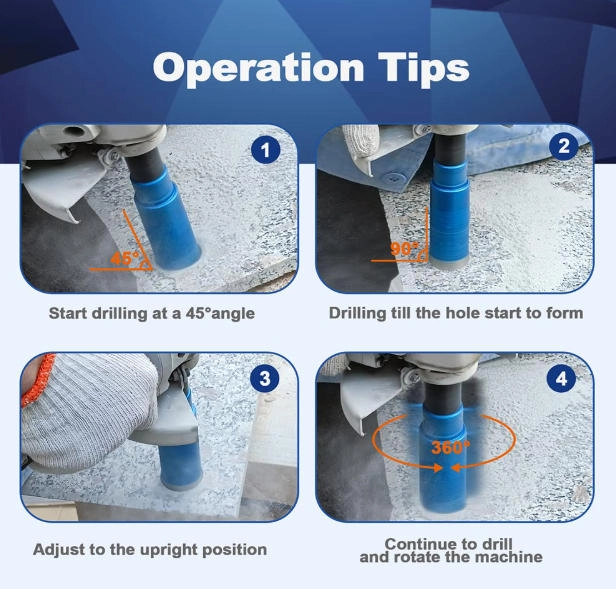
• Start groove (template/pilot or slight angle start), then go 90°
• Gentle, steady pressure—don’t force
• Keep cooling consistent (water or dust extraction)
• Retract periodically to clear debris
Finish
• Light pressure at breakthrough
• Remove core safely
• Clean, dry, store
How Does a Diamond Core Drill Work
A diamond core drill removes material as a cylinder (“core”) instead of pulverizing everything like a percussion tool. That’s why it’s widely used for pipe penetrations, HVAC sleeves, anchor/handrail holes, and retrofit openings in concrete, reinforced concrete, brick, and block.
The core bit is a steel tube with diamond segments at the cutting edge. As it rotates, diamonds grind the base material while water (wet drilling) helps cool the bit and carry out slurry. In dry coring setups, dust control becomes the priority—especially indoors—because concrete drilling can generate respirable crystalline silica.
Choose hand-held vs. rig-mounted
•Hand-held coring: faster setup, best for smaller diameters and light-duty work where control is strong.
•Rig-mounted coring (stand/anchor/vacuum base): the go-to for larger holes, deeper drilling, overhead drilling, and consistent accuracy.
Preparation & Safety
Before you touch the trigger, handle these three risks: hidden utilities, dust exposure, and kickback/jamming.
Concrete drilling can release fine silica dust; OSHA specifically highlights drilling as a task that can generate respirable crystalline silica, and recommends controls like wet methods and/or effective dust collection depending on the task.
Safety checklist:
| Item | What to do | Why it matters |
|---|---|---|
| PPE | Eye protection, hearing protection, gloves; add appropriate respiratory protection if dust is present | Protects against slurry splash, chips, and dust |
| Scan the wall/slab | Use a scanner to locate pipes, wires, rebar/post-tension zones where applicable | Prevents strikes, rework, and dangerous incidents |
| Work zone | Clear footing, secure cords/hoses, plan slurry containment | Prevents slips and loss of control |
| Electrical safety (wet drilling) | Use GFCI/RCD protection and manage water so it can’t run into the tool | Reduces shock risk; many manufacturers include GFCI-related guidance in instructions |
Tools & Accessories You Actually Need
A lot of drilling “problems” are really accessory problems: no guidance at startup, wrong adapter, poor water delivery, or no plan for slurry/dust.
Core bit type: wet vs. dry vs. dual-rated
•Wet core bits: best for concrete and most masonry when water is allowed—cooler cutting, longer life, and better dust suppression.
•Dry core bits: used when water is restricted; they rely on airflow/dust extraction and correct technique. Many dry-drilling guides explicitly warn against hammer action and emphasize rotary-only drilling.
Pilot bit / centering guide / template
•Pilot bit (centering bit): helps start accurately and reduces “walking.”
•Guide plate/template: ideal on smooth surfaces or when a pilot isn’t used.
•Rig/stand: the most reliable “guide” for straight, repeatable holes.
Accessory selector table:
| Situation | Best add-on | What it improves |
|---|---|---|
| Smooth surface, no pilot | Guide plate/template + angle-start technique | Prevents skating/walking |
| Large diameter / deep hole | Core drill stand (anchor/vacuum base) | Straightness, safety, less fatigue |
| Indoor work | Dust extraction (dry) or wet coring with containment | Cleaner site, safer air |
| Overhead drilling | Water collection system + stand | Slurry control and stability |
>> Browse our product catalog
Step-by-step: How to Use a Diamond Core Drill
This is the process you can teach a new operator and still trust the hole quality.
Step 1 — Attach the core bit correctly (and add a pilot if your system uses one)
•Thread the bit onto the correct arbor/adapter.
•Tighten to spec (hand-tight + wrench if required by your system).
•If using a pilot/centering bit, install it fully and confirm it runs true.
Pro check: spin the bit by hand before power-on. If it wobbles, stop—misalignment causes slow drilling, heat, and premature segment wear.
Step 2 — Start the hole without walking: begin at a slight angle, then true up
If you don’t have a pilot or template, start with the bit tilted (often around 45°) to “scratch” a shallow groove, then gradually bring it to 90° once the kerf is established. This is a common, proven technique for preventing a diamond bit from skating on smooth surfaces.
Step 3 — Drill at 90° with steady, gentle pressure
Once the groove is set, straighten to perpendicular and apply even pressure. Let the diamonds cut—forcing it can glaze segments, overheat the barrel, and trigger jamming. If you feel the motor bog down, that’s a signal to reduce pressure or improve cooling/evacuation.
Step 4 — Manage cooling and dust: wet drilling is usually the safest default
For rig-mounted core drilling, OSHA notes that wet methods (continuous water directed at the bit) can effectively reduce silica dust.
•Wet drilling: keep a consistent water feed to cool and flush cuttings (you want slurry moving, not baking).
•Dry drilling: use proper dust extraction, maintain airflow, and pace the cut to avoid overheating.
Step 5 — Clear debris to prevent jamming (the “drill–retract–flush” rhythm)
Every so often, retract the bit slightly to let slurry/dust clear and to reduce binding. This simple habit is one of the biggest differences between smooth coring and stuck bits—especially in deeper holes.
Step 6 — For thick walls, avoid blowout by drilling from both sides (when possible)
If you can access both sides, drill to about halfway, then finish from the opposite side using the pilot hole for alignment. The exit edge stays cleaner and you reduce spalling at breakthrough.
Step 7 — Break through cleanly, remove the core, and shut down safely
As you approach breakthrough, lighten pressure to avoid grabbing. Once through:
•Stop the drill.
•Remove the core plug (don’t pry aggressively at the cutting edge).
•Flush/clean the bit and connection, then store dry to reduce corrosion.
Wet vs. Dry Core Drilling: Which One Should You Use?
Wet drilling is often the best choice for performance and dust control. OSHA’s guidance for core drilling emphasizes wet methods as an effective control for silica when using rig-mounted core saws/drills.
| Factor | Wet core drilling | Dry core drilling |
|---|---|---|
| Dust | Much lower airborne dust (slurry instead) | Requires strong dust extraction/controls |
| Bit temperature | Cooler, more stable | Higher heat risk if paced poorly |
| Site cleanup | Slurry containment needed | Dust containment needed |
| Best for | Concrete/masonry, longer holes, many indoor jobs | Water-restricted sites, specific systems |
More read: How to Choose the Right Diamond Core Drill Bit: A Manufacturer’s Expert Guide
How to Make the Hole Faster, Cleaner, and More Repeatable
RPM & gear selection (keep it simple)
Don’t chase maximum speed. In general:
•Larger diameters like lower speed / higher torque
•Smaller diameters tolerate higher speed
Use your machine’s recommended gear ranges; for example, many core drills provide multiple gears with different RPM bands.
Pressure & feed rate (the “sound test”)
A good cut sounds steady—not screechy, not bogging. If the pitch climbs and progress stops, you may be glazing. If the motor drops hard, you’re over-feeding.
Cooling flow (wet drilling)
Enough water is “enough” when:
•slurry is moving out of the kerf,
•the bit isn’t discoloring from heat,
•you’re not flooding the site unnecessarily.
If you want cleaner wet coring, water management systems can capture and recycle slurry to reduce mess.
Troubleshooting: Common Problems and Fixes
| Symptom | Likely cause | Fast fix | Prevent next time |
|---|---|---|---|
| Bit walks/skates | No pilot/guide, smooth surface | Use template, angle-start groove | Add centering, reduce initial pressure |
| Drilling slows a lot | Low pressure, wrong bit bond, glazing | Adjust feed, “dress”/sharpen on abrasive material (if applicable), check water | Match bit to material; maintain water flow |
| Overheating | Too little water/airflow, over-feeding | Increase cooling, reduce pressure, retract to flush | Set a drilling rhythm; don’t stall the bit |
| Bit jams/binds | Packed debris, misalignment, aggressive feed | Stop, retract, clear kerf | Retract periodically; ensure straight setup |
| Safety clutch trips / motor stops | Jam protection engaged | Follow manufacturer jam procedure | Keep evacuation consistent |
What to do if the core bit gets stuck (don’t hammer it out)
Many manufacturers and diamond tool specialists recommend a threaded-rod method to push against the core and back the bit out, instead of beating on the barrel.
Also note: some core drills include a safety clutch and specific “jam recovery” procedure in the operating instructions—follow that sequence before forcing anything.
More read: Core Drilling Essentials – A Comprehensive Practical Guide
Post-Drilling Core Bit Care
• Clean the connection end (threads/chuck area) and lightly lubricate if your system requires it.
• Flush the barrel so slurry doesn’t harden inside.
• Dry and store properly to reduce corrosion.
• Track performance: if one bit suddenly slows across jobs, it may be the wrong specification for the aggregate/rebar content, or it may need dressing.
More read: How Long Do Diamond Core Bits Really Last?
FAQ
•Can you use hammer mode with a diamond core bit?
No—diamond coring is designed for rotary cutting. If your drill has hammer capability, switch to rotary-only to avoid excessive wear and higher binding risk.
•Wet core drilling vs dry core drilling: which is better?
Wet drilling is often preferred because it cools the bit and reduces airborne silica dust; OSHA notes wet methods are effective for reducing dust when using rig-mounted core saws/drills.
•How do you start a diamond core drill without the bit walking?
Use a pilot/centering system or a guide plate. If neither is available, start with a slight angle to cut a shallow groove, then bring the drill to 90° once it’s tracking.
•How often should I retract the bit to clear debris?
Often enough that the kerf doesn’t pack with slurry/dust—deeper holes and dry drilling typically require more frequent clearing to prevent jamming.
•What should I do if the core bit gets stuck?
Stop the tool, follow the drill’s jam procedure if provided, and avoid hammering the barrel. The threaded-rod method is a common way to safely back a stuck bit out.
•Do I need a pilot bit for core drilling?
Not always, but it makes starts more accurate. For hand-held coring and smooth surfaces, a pilot/centering guide or a template dramatically reduces skating and rework.